
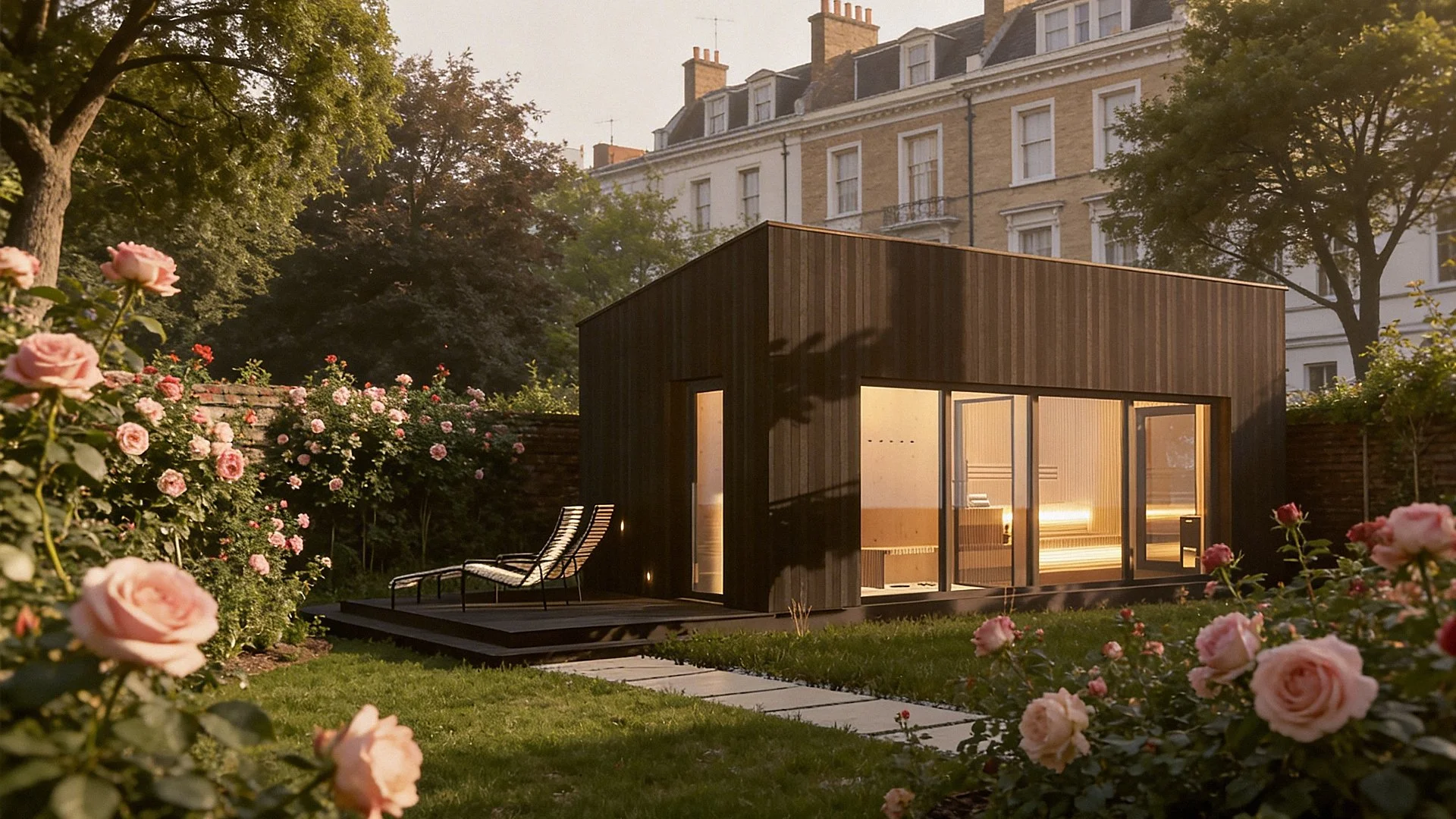
Cross-laminated timber (CLT) has established itself as a structurally precise and thermally capable material for modular construction, and its application to garden annexes in the United Kingdom represents a natural extension of its proven performance in commercial and residential buildings. A garden annexe built using CLT panels offers a fundamentally different structural proposition to traditional masonry or light-timber-frame outbuildings: it is engineered from the panel level upwards, with dimensional tolerances set in a controlled factory environment rather than accumulated through sequential on-site trades. The result is a structure that can be installed within defined dimensional limits under caravan legislation whilst delivering a standard of thermal, acoustic, and spatial performance that compares directly with permanent residential construction.
The growing interest in garden annexes reflects a convergence of several distinct pressures: an ageing population seeking to accommodate dependent relatives without the disruption or cost of care facilities; a planning environment that, in certain circumstances, treats caravan-classified structures more permissively than permanent outbuildings; and a wider cultural shift towards productive use of residential land. CLT addresses each of these contexts with a construction system that is fast to install, structurally robust, and capable of being specified to meet demanding performance benchmarks. This article sets out the technical basis for CLT as a garden annexe material, explains the regulatory framework within which these structures operate in the UK, and describes the specific advantages that factory-manufactured CLT modules offer over conventional garden building methods.
What Is Cross-Laminated Timber and Why Does It Matter for Garden Annexes?
Cross-laminated timber is manufactured by bonding kiln-dried timber boards in alternating perpendicular layers under controlled pressure, typically in 3, 5, or 7 plies depending on structural requirements. The cross-lamination distributes load in 2 directions simultaneously, giving the panel plate-like structural behaviour: it can carry vertical loads as a wall, spanning loads as a floor or roof, and in-plane shear loads as a diaphragm resisting lateral forces. This structural versatility is the foundational reason CLT suits modular construction so well. A single panel type can fulfil the roles that in traditional construction are performed by separate elements: a masonry cavity wall, a timber joist floor, and a pitched or flat roof structure, each requiring independent trades and sequential programme time.
In the context of a garden annexe, the practical consequence is significant. The entire structural shell of a CLT module can be fabricated off-site using CNC-cut panels, transported to the plot, and placed on a prepared foundation in a single operation. No on-site assembly is required; the module arrives fully fabricated and fitted out, with only utility connections needed before occupation. Openings for windows and doors are cut to precise tolerances in the factory, eliminating the on-site measurement variables that contribute to thermal bridging and airtightness failures in site-built construction. The module arrives with all structural, thermal, acoustic, and service elements integrated within the factory-fabricated unit, eliminating the sequential on-site trades that generate programme risk and quality variability in conventional garden building construction.
CLT also delivers a high strength-to-weight ratio. Compared with reinforced concrete or dense masonry, CLT panels impose substantially lower loads on the foundation, which simplifies ground preparation for garden annexe installations, particularly where the underlying ground conditions are modest or where the client wishes to avoid significant civil engineering works. The reduced foundation complexity contributes directly to the speed and cost predictability of CLT garden annexe installation.
Caravan Legislation and the Garden Annexe Classification
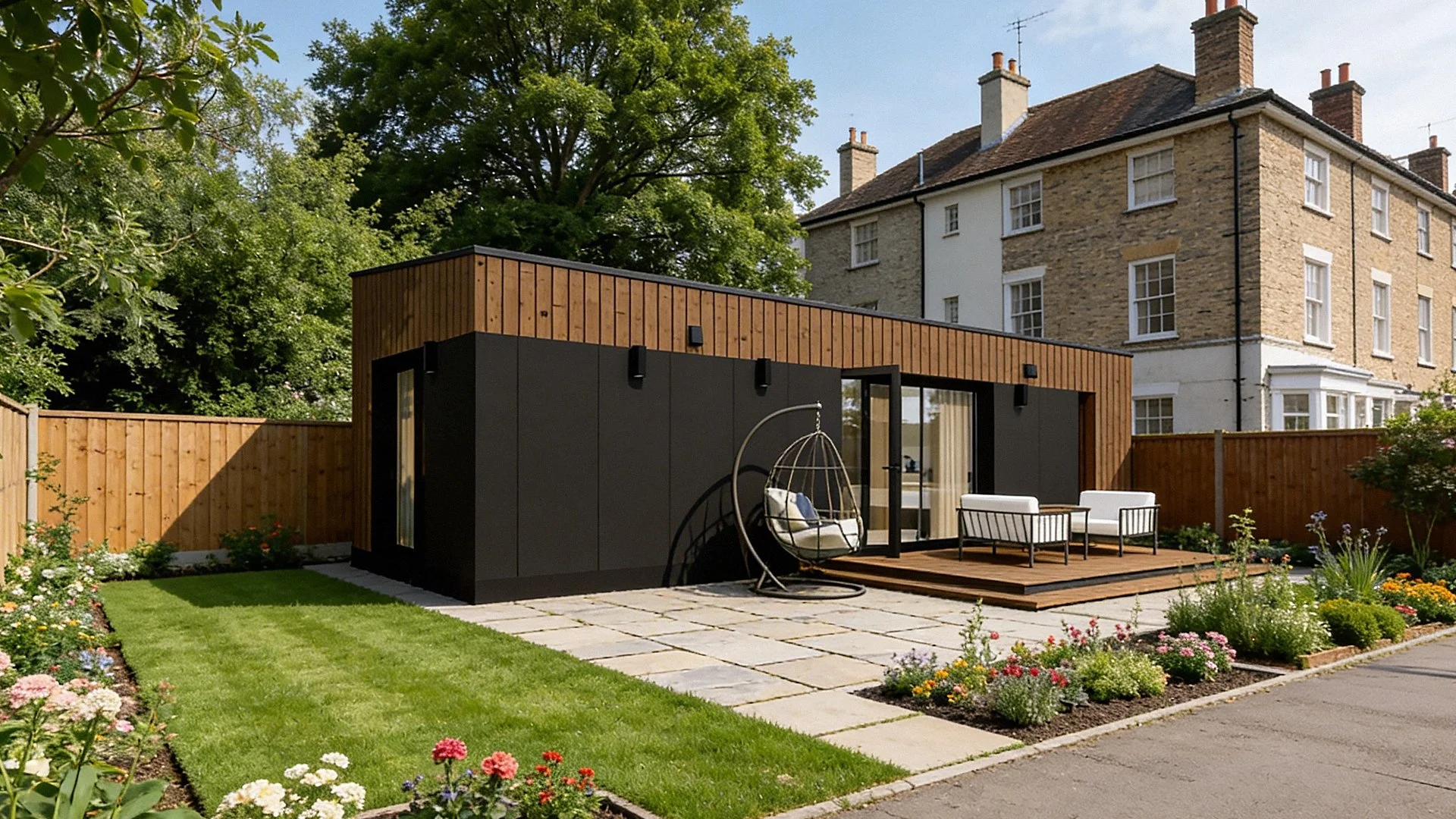
In the UK, many garden annexes are designed to fall within the legal definition of a caravan under the Caravans Act 1968 (as amended). The significance of this classification relates primarily to planning: structures that meet the statutory definition are treated differently from permanent buildings in certain planning contexts, and for some homeowners this can simplify the path to installation.
To qualify as a caravan under the Act, the structure must stay within specific dimensional limits: a maximum length of 20 m, a maximum width of 6.8 m, and a maximum internal floor-to-ceiling height of 3.05 m. It must also be capable of being transported in no more than 2 sections and assembled on site. These are cumulative criteria: a structure that meets the dimensional limits but cannot be transported in 2 sections does not qualify, and vice versa. Celtio's standard models are single-module units, transported and placed in a single operation, and the factory fabrication process is designed within the dimensional envelope from the outset to ensure the finished module meets the statutory criteria without modification on site.
It is important to state clearly that classification under caravan legislation does not remove the need to consider planning permission. The caravan definition determines how a structure is categorised for certain regulatory purposes, but whether a specific installation requires planning consent depends on the character of the site, the existing use, whether the local planning authority has removed any permitted development rights, and the planning policies applicable to that location. Homeowners should seek advice from their local planning authority before proceeding with any garden annexe installation, regardless of how the structure is classified.
The ability to maintain caravan-type dimensional and mobility criteria while still delivering residential-grade performance is a significant advantage over many traditional masonry garden builds, which are normally treated as permanent structures subject to full planning and Building Regulations controls. A masonry outbuilding of comparable size, built on a concrete slab with a tiled roof, would in most cases require full planning permission and Building Regulations approval, adding time, cost, and uncertainty to the project. The CLT modular approach, designed within the caravan classification limits from the outset, offers a more predictable regulatory pathway, though that pathway must still be confirmed with the local planning authority on a site-specific basis.
Planning and classification outcomes are always site-specific; professional advice should be taken for each project.
BS 3632 and Residential Performance Standards
BS 3632 is the British Standard for residential park homes. In its current form, BS 3632:2023, it sets specific requirements for thermal transmittance (U-values), airtightness, ventilation, fire safety, structural performance, and durability that together constitute a framework for year-round habitable accommodation. The standard is principally applied to park homes and residential caravans, but its performance thresholds are increasingly referenced as a benchmark for any modular or caravan-classified structure intended for residential-grade occupation.
When combined with high-performance insulation systems and appropriate construction detailing, CLT modules can be engineered to meet residential performance benchmarks such as those in BS 3632:2023 for park homes. The natural thermal mass of CLT panels, combined with continuous mineral wool insulation, vapour control layers, and thermally broken junction details, allows the building fabric to achieve U-values approaching those required in new-build permanent housing. The solid-panel nature of CLT, as opposed to the open cavities of light-timber-frame construction, also reduces the risk of interstitial condensation when correctly detailed, and delivers superior acoustic insulation compared with very lightweight stud-and-board assemblies.
Airtightness is another area where CLT performs well relative to site-built alternatives, provided the panel junctions and service penetrations are detailed carefully. Factory fabrication reduces the number of variables that contribute to airtightness failures: panels are cut to precise dimensions, and the installation sequence can be designed to ensure continuous sealing at each joint. In a site-built structure, the same joints are formed by multiple trades working in sequence, with each handover introducing a potential point of discontinuity in the airtightness layer.
When designed and constructed to the requirements of BS 3632:2023 and kept within caravan classification limits, these annexes can combine residential-grade performance with caravan status. This is not an automatic outcome of using CLT; it is a result of a deliberate specification process in which the panel system, insulation thickness, vapour control strategy, window U-values, ventilation system, and junction details are collectively optimised against the standard's requirements. Celtio's design and engineering process is structured around this objective, with each structure designed to achieve residential performance standards aligned with BS 3632, supporting year-round comfort and robust thermal and acoustic performance.
Technical Performance Characteristics of CLT Garden Annexes
Thermal Performance
The thermal performance of a CLT garden annexe is determined by the combined effect of the CLT panels, the insulation layer, the window and door specifications, and the quality of the airtightness and vapour control detailing. CLT panels themselves have a relatively low thermal conductivity for a structural material, but the primary contribution to the overall wall U-value comes from the added insulation, typically mineral wool or rigid PIR board depending on the wall build-up. When combined, well-specified CLT wall constructions can achieve U-values of 0.18 W/m²K or below, which aligns with the requirements of BS 3632:2023 and represents performance comparable to a new-build permanent dwelling under current Building Regulations.
The absence of a traditional stud cavity in CLT construction eliminates 1 of the most common sources of thermal bridging in timber-frame buildings: the repeated interruption of the insulation layer by structural studs. CLT walls are structurally continuous, so the insulation can be applied as an unbroken external or internal layer without structural interruption, reducing linear thermal bridges at the perimeter and improving the correlation between calculated and as-built U-values.
Moisture Control and Long-term Durability
CLT panels are manufactured from kiln-dried timber with moisture content controlled to within tight limits, typically between 10% and 14%. This controlled starting point reduces the risk of movement, distortion, or fungal growth in the structural panels over the building's life. The cross-laminated structure itself has good dimensional stability under varying humidity conditions, which is an important characteristic for a garden annexe that may not be continuously heated throughout the year.
As with any timber system, long-term durability depends on correct detailing, ventilation, and maintenance to keep moisture within controlled limits. This means that the CLT panel itself acts as the primary vapour retarder by virtue of its mass and density; that the windproof foil on the cold face of the insulation must be correctly installed and lapped to prevent wind-driven moisture ingress into the rock wool layer; and that the building is ventilated in a way that prevents condensation accumulating within the structure. These requirements are not unique to CLT, but the factory fabrication environment makes it more straightforward to specify and verify the correct details before the structure leaves the manufacturing facility.
Acoustic Performance
CLT panels provide better acoustic separation than lightweight stud-and-board wall systems because of their mass and structural continuity. A solid CLT panel offers inherent resistance to airborne sound transmission that a cavity stud wall, with its inherently discontinuous structure, can only approximate by adding additional mass and resilience layers. For a garden annexe intended for use as a self-contained living space, this matters in 2 directions: it reduces sound transmission from the main house or garden into the annexe, and it provides privacy for the occupant.
Where enhanced acoustic performance is required, CLT can be combined with resilient fixings, floating floor constructions, and acoustic infill between the structural panel and the internal lining. The factory fabrication environment allows these details to be incorporated with greater consistency than site-built alternatives.
Speed of Installation and Programme Certainty
A CLT garden annexe module, manufactured and fitted out in a factory, can typically be positioned on a prepared foundation within a single day. The crane lift and connection of services represent the primary on-site activities; the lengthy on-site construction programme of a traditionally built outbuilding (groundworks, masonry, roof structure, first fix, second fix, decoration) is replaced by a single placement event followed by utility connection.
This programme compression has direct financial implications for the client, who avoids weeks of disruption, and removes the weather dependency that contributes to cost overruns and programme slippage in site-built construction. The total project cost can be fixed at contract signature, because the scope of work is defined by the factory-manufactured module rather than by an accumulation of site-specific variables.
Sustainability
CLT is manufactured from sustainably sourced timber, typically certified under FSC or PEFC schemes, and timber construction stores carbon in the structural fabric of the building throughout its service life. This is a material distinction from masonry or steel construction, where the manufacturing process is inherently carbon-intensive and there is no ongoing carbon storage benefit. For clients who attach weight to the embodied carbon profile of their construction projects, CLT represents a demonstrably lower-impact structural choice.
The factory fabrication process also generates less waste than site-built construction: panels are cut to precise dimensions using CNC equipment, and offcuts can be collected and processed at the manufacturing facility rather than accumulated as site waste.
Design Flexibility
CLT modules can accommodate a wide range of internal layouts, external cladding systems, and roof configurations within the caravan classification dimensional limits. The structural capability of CLT panels means that internal partitions are not required for structural purposes, allowing open-plan configurations that would be difficult to achieve with loadbearing masonry. External cladding options include timber board, fibre cement, and metal cladding systems, allowing the annexe to be specified in keeping with the main house or garden aesthetic.
Property Value
A well-specified, self-contained garden annexe can have a positive effect on the market value of the host property. The addition of a high-specification living space designed and finished to a standard that competes with purpose-built residential accommodation is consistently cited by property agents as a favourable factor in valuations. The extent of any uplift depends on the specific property, its location, and prevailing market conditions, and homeowners should obtain independent valuation advice rather than rely on generalised estimates.
How Celtio Supports Garden Annexe Projects
Each Celtio structure is engineered within Caravan Act dimensional limits and designed to achieve residential performance standards aligned with BS 3632, supporting year-round comfort and robust thermal and acoustic performance. The design process integrates structural engineering, thermal modelling, and airtightness detailing within a single factory-controlled environment, producing a module that arrives on site with a defined performance specification rather than a set of aspirations to be achieved through sequential on-site trades.
Celtio's approach addresses the 3 principal risks that attach to garden annexe projects: regulatory uncertainty, construction programme risk, and performance shortfall. Regulatory uncertainty is managed through careful dimensional design within the caravan classification limits and active engagement with the client's planning position before the project commences. Construction programme risk is eliminated by the factory fabrication model, which removes weather dependency, trades coordination risk, and materials price exposure from the project timeline. Performance shortfall is addressed through a specification process that is benchmarked against BS 3632:2023 from the outset, with thermal, airtightness, and acoustic performance verified against the standard's requirements before the module enters production.
A garden annexe built with CLT is not simply an additional structure. It is a durable and adaptable living environment that can be engineered to meet demanding residential performance expectations, and when classified appropriately and correctly sited, it can provide that environment within a regulatory and planning framework that is more accessible than permanent construction for many homeowners.
Classification under caravan legislation and the planning implications for any given site are subject to the specific circumstances of that site and the policy position of the relevant local planning authority. This article provides general information only and does not constitute legal or planning advice. Prospective clients should obtain independent professional advice before proceeding.
